
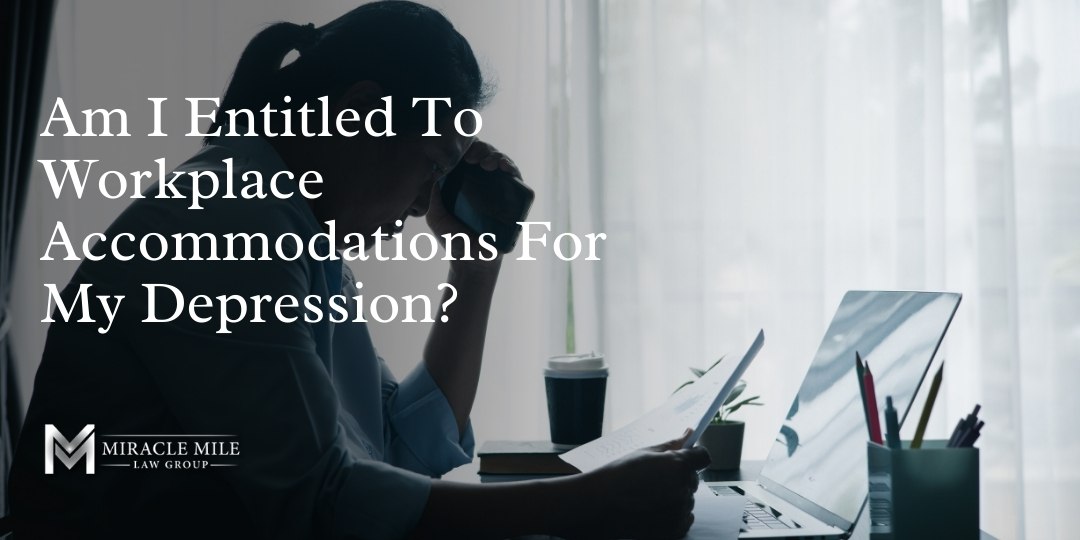
Am I Entitled To Workplace Accommodations For My Depression?
Depression is a serious mental health condition that can affect concentration, energy levels, sleep, motivation, and overall functioning. Many California employees struggle with whether they have legal rights at work when their depression interferes with job performance. Under California law, the answer is often yes. Employees with depression may be entitled to reasonable workplace accommodations if their condition meets the legal definition of a disability.
This article explains how California law applies to depression, what accommodations may be available, and what employers are required to do.
Does Depression Qualify For Workplace Accommodations
In California, depression can qualify as a disability under the Fair Employment and Housing Act, commonly known as FEHA. FEHA provides broader protections than the federal Americans with Disabilities Act.
Under FEHA, a mental health condition qualifies as a disability if it limits a major life activity. Major life activities include working, concentrating, thinking, interacting with others, sleeping, and performing daily tasks. The term “limits” under FEHA is interpreted broadly. The condition does not need to make the activity impossible. It only needs to make the activity more difficult.
Clinical depression, major depressive disorder, persistent depressive disorder, and similar medically recognized conditions may qualify if they limit a major life activity. Temporary stress or ordinary workplace dissatisfaction does not automatically qualify. The condition must be supported by medical documentation and have a functional impact.
If depression qualifies as a disability and the employee can perform the essential functions of the job with or without reasonable accommodation, the employer has legal obligations.
What Constitutes Depression That Requires Workplace Accommodations
Not every diagnosis automatically requires accommodation. The key legal question is whether the depression limits the employee’s ability to perform essential job functions.
Factors that matter include:
- A formal diagnosis from a licensed healthcare provider
- Documented symptoms that affect concentration, memory, attendance, communication, or stamina
- A connection between symptoms and workplace performance limitations
- A recommendation from a provider identifying work-related restrictions or needs
For example, an employee experiencing severe fatigue, difficulty focusing, panic episodes, or medication side effects may require adjustments. An employee who is fully able to perform their job without modification may not need accommodation, even if they have a diagnosis.
California law focuses on functional limitations, not labels. The employer is entitled to documentation confirming the existence of a condition and describing work-related limitations, but the employer is not entitled to full medical records or detailed psychiatric history.
What Kinds Of Workplace Accommodations Are There For Depression
Reasonable accommodations must address the employee’s specific limitations. They must allow the employee to perform essential job duties without imposing undue hardship on the employer.
Common accommodations for depression may include:
- Modified work schedules, such as later start times
- Flexible scheduling to attend therapy or medical appointments
- Remote or hybrid work arrangements when job duties allow
- Additional breaks during the workday
- Temporary reduction of non-essential job duties
- Adjusted productivity expectations during treatment periods
- Quiet workspace modifications to reduce distractions
- Reassignment to a vacant position when appropriate
Accommodations are individualized. There is no fixed list. The employer is not required to eliminate essential job functions, create a new position, or retain an employee who cannot perform the essential functions of the job even with reasonable accommodation.
Employers must engage in what is called the interactive process. This is a good faith dialogue between employer and employee to determine an effective accommodation. Failure to engage in the interactive process can itself violate FEHA.
Are Workplace Accommodations For Depression Common
Mental health accommodations are increasingly common in California workplaces. Employers with five or more employees are covered by FEHA and must comply with disability accommodation requirements.
In practice, many employers routinely provide schedule adjustments, leave modifications, or remote work options for mental health conditions. However, disputes arise when employers:
- Deny the condition qualifies as a disability
- Claim the requested accommodation is too burdensome
- Fail to respond to requests
- Discipline employees instead of engaging in the interactive process
The law does not require the employer to provide the employee’s preferred accommodation. The employer must provide an effective accommodation, not necessarily the exact one requested. If multiple reasonable options exist, the employer may choose among them.
Is It Illegal For Your Employer To Not Accommodate Clinical Depression
Yes, if clinical depression qualifies as a disability under FEHA and the employee can perform essential job functions with a reasonable accommodation, it is unlawful for the employer to refuse accommodation without a valid reason.
An employer violates California law if it:
- Refuses to provide reasonable accommodation without demonstrating undue hardship
- Fails to engage in the interactive process in good faith
- Retaliates against an employee for requesting accommodation
- Terminates or demotes an employee because of their depression
Undue hardship means significant difficulty or expense in relation to the employer’s size, resources, and operations. Large employers generally have a higher burden to prove hardship than small employers.
Retaliation for requesting accommodation is separately prohibited. An employer cannot lawfully punish, demote, discipline, or fire an employee simply for asserting disability rights.
How To Request A Workplace Accommodation For Depression
Under California law, an employee does not need to use specific legal language. The employee must communicate that they have a medical condition and need adjustment or assistance at work.
Best practices include:
- Making the request in writing
- Providing documentation from a healthcare provider describing limitations
- Identifying how symptoms affect job performance
- Suggesting potential accommodations
Once the request is made, the employer must respond and begin the interactive process. Ignoring the request or delaying without explanation may violate FEHA.
If the employer denies the request, the employee may have options through the California Civil Rights Department or through a civil lawsuit.
Final Considerations For California Employees
Depression can qualify as a protected disability under California law when it limits a major life activity. Employees are entitled to reasonable accommodations that allow them to perform essential job duties. Employers must engage in a good faith interactive process and cannot retaliate against employees who request accommodation.
Each case depends on specific medical documentation, job duties, and employer response. Employees who believe their rights have been violated should seek individualized legal advice to evaluate their situation under California law.

Related Posts

Written By