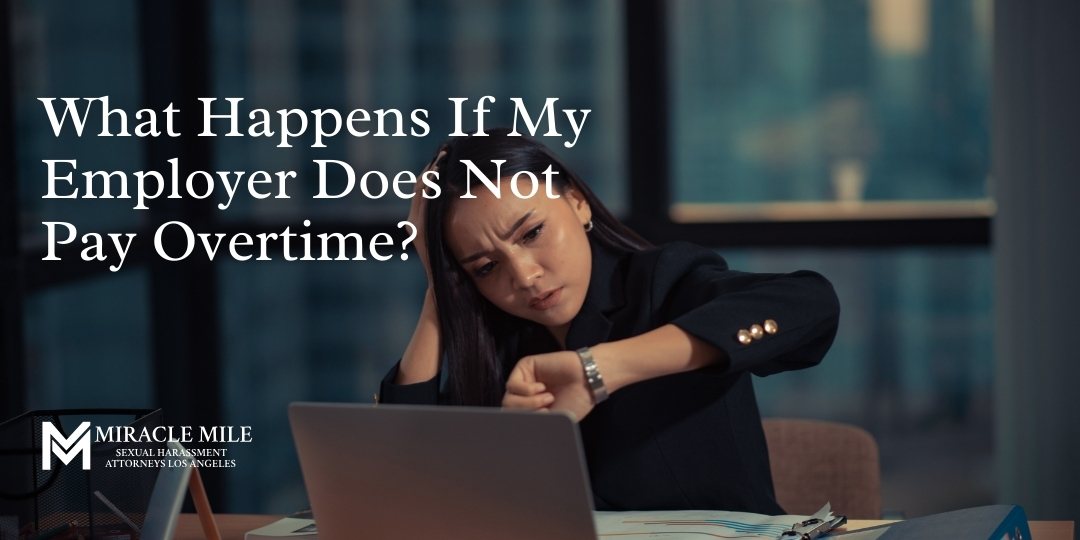
What Happens If My Employer Does Not Pay Overtime?
California overtime law gives employees important wage protections. When an employer fails to pay overtime, the problem can lead to unpaid wages, penalties, interest, wage statement violations, and legal claims under state law. For many workers, unpaid overtime adds up quickly, especially when the issue continues for months or years.
At Miracle Mile Law Group, we help California employees understand their rights when employers underpay wages. If your employer has not paid overtime correctly, you may be able to recover the unpaid amounts and additional compensation allowed by law.
How Overtime Works in California
California overtime rules are generally more protective than federal law. In many cases, nonexempt employees must receive:
- One and one-half times their regular rate of pay for hours worked over 8 in a workday
- One and one-half times their regular rate of pay for hours worked over 40 in a workweek
- One and one-half times their regular rate of pay for the first 8 hours worked on the seventh consecutive day of work in a workweek
- Double time for hours worked over 12 in a workday
- Double time for hours worked over 8 on the seventh consecutive day of work in a workweek
These rules usually apply to nonexempt employees. Whether you are entitled to overtime depends on your actual job duties, how you are paid, and whether an exemption applies. An employer cannot avoid overtime obligations simply by paying a salary or giving a job title that sounds managerial.
What Counts as Failing to Pay Overtime?
An overtime violation can happen in several ways. Some employers openly refuse to pay overtime. Others underpay workers through payroll practices that hide the violation.
Common examples include:
- Paying straight time for hours that should be paid at time and a half or double time
- Misclassifying employees as exempt from overtime
- Misclassifying workers as independent contractors
- Failing to include bonuses, commissions, or differentials in the regular rate used to calculate overtime
- Editing time records to remove extra hours
- Requiring off-the-clock work before shifts, after shifts, or during meal breaks
- Using unlawful rounding practices that reduce payable time
- Pressuring employees not to record all hours worked
- Providing compensatory time instead of overtime pay in a private-sector job
Even small errors in timekeeping or payroll calculations can become significant when repeated across many pay periods.
What Happens Legally If an Employer Does Not Pay Overtime?
If your employer does not pay overtime, you may have the right to bring a wage claim or file a lawsuit to recover what you are owed. Depending on the facts, the employer may be responsible for:
- Unpaid overtime wages
- Interest on unpaid wages
- Waiting time penalties if final wages were not paid correctly when employment ended
- Wage statement penalties for inaccurate pay stubs
- Attorneys’ fees and costs in some claims
- Civil penalties under the California Labor Code
Some cases also involve claims for meal and rest break violations, minimum wage violations, unreimbursed business expenses, or retaliation. Wage and hour violations often overlap, so a full legal review is important.
Unpaid Overtime Wages
The starting point in most cases is the amount of overtime you should have been paid. This can include unpaid time and a half or double time. If your regular rate was calculated incorrectly, the unpaid amount may be higher than it first appears.
For example, overtime is generally based on the regular rate of pay, which can include more than your base hourly rate. Nondiscretionary bonuses, shift differentials, and certain commissions may need to be included in the calculation. If an employer leaves those amounts out, every overtime payment may be too low.
Waiting Time Penalties
When an employee leaves a job, California law requires timely payment of all earned wages, including overtime. If an employer willfully fails to pay all wages due at termination or resignation, the employee may recover waiting time penalties. These penalties can continue for up to 30 days based on the employee’s daily wage rate.
This issue often arises when a worker is fired or quits and then discovers that final pay did not include unpaid overtime from prior pay periods.
Wage Statement Penalties
California employers must provide accurate itemized wage statements. If your pay stubs fail to show the correct wages, hours, rates, or other required information, you may have a separate claim for wage statement violations.
In overtime cases, wage statements are often inaccurate because they underreport total hours, omit overtime rates, or show straight-time pay where premium pay should appear.
How Much Time Do You Have to File a Claim?
Deadlines matter. In California, the time to pursue unpaid overtime claims depends on the type of claim asserted. Different statutes of limitation may apply under the Labor Code, a wage order, or unfair competition law. Waiting too long can reduce or eliminate what you can recover.
Because these deadlines can be complicated, employees should speak with a California employment attorney as soon as they suspect an overtime violation.
Can Your Employer Retaliate Against You for Asking About Overtime?
California law prohibits retaliation against employees who assert wage rights, complain about unpaid wages, ask for lawful overtime pay, file a claim, or participate in an investigation. Retaliation may include termination, demotion, reduced hours, discipline, threats, schedule changes, or other adverse treatment.
If your employer punishes you for raising overtime concerns, you may have an additional legal claim beyond the unpaid wage issue itself.
Common Employer Defenses in Overtime Cases
Employers often try to defend overtime claims by arguing that the employee was exempt, never worked the claimed hours, failed to report the time, or agreed to the pay arrangement. In California, these defenses do not automatically defeat a claim.
For example:
- An employee cannot waive the right to overtime pay through a private agreement
- An employer may still be liable if it knew or should have known that off-the-clock work was being performed
- A salary alone does not prove exempt status
- Job titles do not control whether an employee is exempt
Courts and agencies look closely at the actual work performed and the employer’s real practices.
Employees Commonly Affected by Overtime Violations
Unpaid overtime can affect workers in many industries, including:
- Retail
- Hospitality
- Restaurants
- Healthcare
- Construction
- Transportation and delivery
- Warehousing
- Security
- Office and administrative work
- Call centers
- Tech and startup environments
Violations are especially common where employees are expected to answer messages after hours, work through breaks, arrive early for setup, or finish tasks after clocking out.
Signs You May Be Owed Overtime
You may want to speak with an attorney if any of the following apply:
- You regularly work more than 8 hours in a day or 40 hours in a week without overtime pay
- You are paid a salary and told that means you do not get overtime, even though your job duties are not truly exempt
- You perform work before clocking in or after clocking out
- You are told to stay under 40 hours on paper even though you work more
- Your employer changes time records
- Your pay stubs do not match the hours you actually worked
- You receive bonuses or commissions, but overtime is still calculated only on your base rate
- You were terminated and your final pay did not include all overtime owed
What Evidence Can Help Prove an Overtime Claim?
Employees do not need perfect records to bring a claim, especially when the employer failed to maintain accurate time records. Helpful evidence can include:
- Pay stubs
- Timecards and schedules
- Personal calendars or notes of hours worked
- Text messages, emails, and app records
- Work orders, delivery logs, or task records
- Coworker statements
- Handbooks and payroll policies
- Final pay records
Keeping your own copy of these records can be useful if you later need to prove unpaid wages.
Administrative Claim or Lawsuit?
In California, unpaid overtime claims may be pursued through an administrative wage claim process or in court. The best path depends on the amount at issue, whether multiple employees are affected, whether there are related claims, and whether the employer is likely to dispute the facts aggressively.
Some cases are suitable for individual litigation. Others may be appropriate for class action treatment if the employer used a common unlawful pay practice affecting many employees.
Overview of Potential Consequences for Employers
| Issue | Possible Consequence |
|---|---|
| Unpaid overtime | Recovery of unpaid wages based on missed time and premium rates |
| Late or incomplete final wages | Waiting time penalties up to 30 days |
| Inaccurate pay stubs | Wage statement penalties |
| Retaliation for complaining | Separate retaliation claim and additional damages or remedies |
| Widespread pay practice affecting multiple workers | Potential representative or class-wide exposure |
What Should You Do If You Suspect Unpaid Overtime?
If you think your employer has not paid overtime correctly, take practical steps right away:
- Save your pay stubs and time records
- Write down the hours you actually worked
- Preserve texts, emails, and scheduling messages
- Request copies of payroll records if needed
- Avoid signing documents you do not understand
- Speak with a California employment attorney promptly
Early legal advice can help you protect your claim, identify all violations, and avoid missing filing deadlines.
If you are dealing with unpaid overtime, off-the-clock work, misclassification, or retaliation at work in California, Miracle Mile Law Group can evaluate your situation and explain your options. Contact Miracle Mile Law Group to discuss whether you may be entitled to unpaid wages, penalties, and other relief under California law.

Related Posts